The StethOscope: Issue 4
Dr. James Aw, Chief Medical Officer, OMERS
September 8, 2026
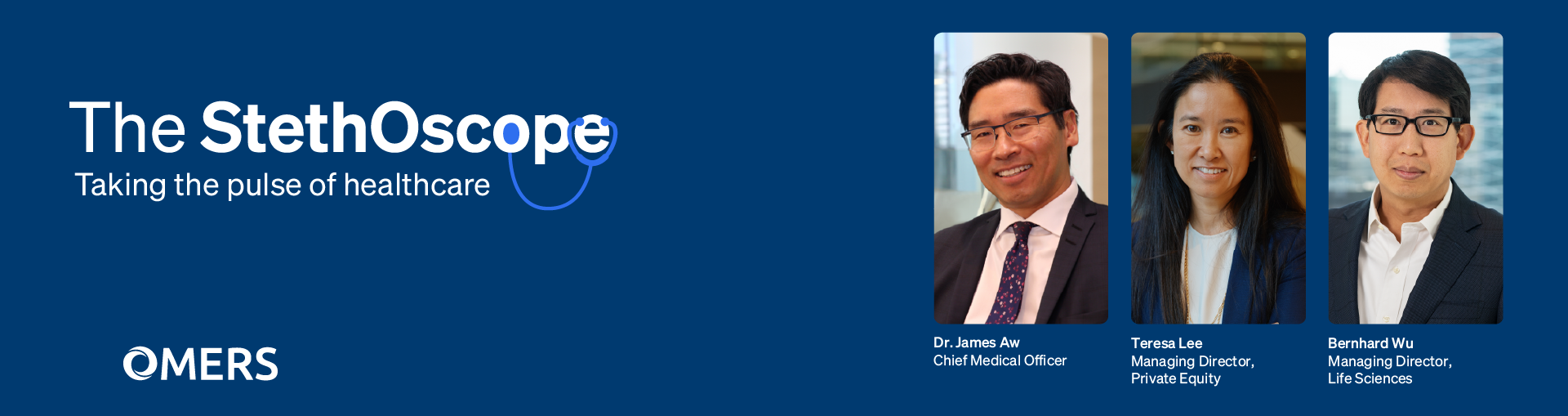
Dr. Aw: Welcome back to The StethOscope! One of the benefits of working at OMERS is the opportunity to learn from investors across different corners of the healthcare ecosystem. As we move through 2026, there’s no shortage of topics to discuss, from innovation and technology to shifting market dynamics and the long-term trends shaping healthcare globally.
For this edition, I’m joined by Teresa Lee and Bernhard Wu, both Managing Directors from our Private Equity group. Teresa focuses on technology, tech-enabled services and healthcare investments across the private equity landscape. Bernhard invests in royalty streams and structured financings that support the development and commercialization of innovative therapies. Thank you both for joining me.
Let’s start with the big picture. As you reflect on the first half of 2026, what stood out to you? Were there any surprises?
Teresa: The first half of 2026 was good for us. While there are pockets of exceptions where deals are getting done for high-quality assets and strategic moves, it’s been a tough few years to get liquidity in the private equity asset class. Despite the market dynamics, we exited the home health care division of a business we have owned since 2011. In that time, the division had grown almost fivefold from an employee count perspective, while always making sure they were delivering quality care and strong health outcomes. That's always been a key part of how we think about services.
We also had a second realization with a good outcome. It's a good value creation story. The business expanded its core and added capabilities into different service lines. It was acquired by a healthcare-focused investor. Its new owner is the right one for the next phase of that business.
So from a first-half perspective, exits were good for us. It's been, and this is no secret, a market that hasn't seen a lot of movement on the bid-ask spread challenge across private equity. We don't see healthcare being terribly different, except in a few pockets.
One challenge we found in the first half of 2026 was that not as many high-quality assets came to market as we expected based on what we heard from bankers and coming out of J.P. Morgan’s annual Healthcare Conference in January. We thought there would be a lot more activity, but right after the conference, there was the "SaaSpocalypse," and I largely focus on tech and tech-enabled services. That created another challenge, especially for healthcare technology businesses.
If your business is operating well, you're going to wait for better market conditions. I wouldn't call it a surprise, but as the year unfolded it became clear, and somewhat unfortunate, that the volume of activity was lower than we had hoped going into the year.
Bernhard: It was a productive first half of the year. While the vast majority of our investments are sourced on a direct basis, the first investment we completed was brought to us by an existing investment partner of OMERS. The investment supports the growth of a commercial-stage company in the neurology space and illustrates the benefits of the broader OMERS platform, where we can leverage relationships and investment opportunities across the organization.
The second investment was a deal where we provided acquisition financing to a public biotech company. They are using the proceeds to acquire another public company that markets and receives a profit share for a commercial drug. Our financing was in the form of a note secured by the profit share. What makes that transaction particularly noteworthy is that it opens another avenue for how we source and structure deals.
Historically, we've purchased royalties on commercialized prescription drugs from companies or academic institutions that have licensed patents. With investments like this, we can also help companies acquire commercial therapeutics while still preserving the investment profile we're looking for.
We also evaluated a number of other interesting opportunities.
Dr. Aw: Looking beyond individual transactions, what do you see as the biggest tailwinds shaping healthcare today?
Bernhard: Innovation is happening so fast, but it costs a lot of money in terms of investment. That creates opportunities for investors who can support drug development and commercialization efforts. At the same time, longevity and an increasing focus on healthspan are creating demand for products that improve quality of life later in life. People are very much willing to spend on improving quality of life, and I think those two trends are definitely tailwinds for the sector.
Teresa: I think the long-term tailwinds Bernhard just mentioned on quality of life and healthspan will continue to be centered on addressing the supply-demand imbalance. Frankly, labour challenges are a major driver of healthcare costs. A lot of things need to come together. I don't think healthcare can continue to lag in technology adoption if we can drive true productivity from a value creation perspective. The mental comfort or psychology around being willing to accept that matters too. Thinking personally, if I told my dad I was going to have a robot come to the house and help him, it would be a non-starter.
Dr. Aw: We can't talk about healthcare today without talking about technology and AI. How are you thinking about its role in the industry? Do you see AI as a tailwind or an unknown?
Bernhard: Theoretically, it should be a tailwind. At what rate remains to be seen.
Dr. Aw: Okay. And when you're saying innovation, you're referring to research and development, biology, science, the science of it, not so much AI efficiency?
Bernhard: Definitely foundational biology.
Dr. Aw: And then the societal pressures that people want to live long, they want to live well. People are going to be using drugs to do so.
Bernhard: There are a couple of interesting trends worth highlighting. The first is growth in the market for synthetic royalty financing. Essentially, we're investing an upfront amount in exchange for a percentage of future sales of a counterparty’s drug. It's a favourable trend because it expands the universe of potential investment opportunities.
The second trend is growth in financing for pre-commercial drugs. We remain focused on commercial-stage assets, but increasingly we're seeing companies seek financing earlier in the development process and more investors willing to underwrite that risk.
Dr. Aw: Has there been any negative impact from regulatory or geopolitical factors? What are headwinds for the sector?
Bernhard: The U.S. is the largest market for prescription drug sales so we are focused on regulatory and geopolitical factors that could impact the industry. Last year, there was a great deal of uncertainty related to potential U.S. government policies including drug pricing, tariffs and how drugs are approved and regulated. The clarity around some of these issues has improved and we are constantly revisiting our due diligence process to make sure we have thought through potential implications of policy change on our investments. We mitigate some of these risk through the diligence process, for example, focusing on drugs that have a pharmacoeconomic benefit to the healthcare system and are manufactured in the U.S., but with global sales.
Dr. Aw: Looking ahead to the rest of 2026, what are you watching most closely?
Teresa: We're certainly hearing a lot more about deals coming to market.
We've been talking for a long time about assets needing new homes across many private equity portfolios, where holding periods are increasingly lengthy. We're hearing that for sure. The skeptic in me, though, notes that we've been hearing this story for years.
At the beginning of every year, everyone says there's going to be a lot of activity, lots of competitive processes and plenty of opportunities. Then by March or April nothing has happened because some macro event gets in the way. Then everyone says, "After Labour Day." But right now, based on both what we're hearing and what we're actually seeing, I do think there will be an increase in assets coming to market. We'll see whether those transactions actually get completed and find new owners, or whether sellers just test the waters and ultimately continue holding the asset.
There are a number of assets we're tracking that we expect to come out during the second half of the year. We're always going to be disciplined and cautious about where we invest. That said, it certainly looks like there will be more opportunities to consider.
Bernhard: The pipeline looks attractive, with a lot of opportunities. We're continuing to see interesting situations across both royalty acquisitions and structured financings, and we're seeing opportunities emerge from a broader range of counterparties and transaction types than we have historically.
What excites me is that we're continuing to see good investment opportunities and that set is expanding. As we've demonstrated through recent transactions, there are opportunities to support acquisitions and commercial therapeutics while maintaining the characteristics we look for in our investments.
Dr. Aw: Before we wrap up, what are you most excited about right now?
Bernhard: We have a couple of people who have joined our team recently which is exciting. We're also seeing an interesting pipeline of opportunities, and the growth of the platform gives us more capacity to evaluate those opportunities and continue building the business.
Dr. Aw: It's always interesting to hear how healthcare investors are thinking about the same themes from different angles. Whether it's innovation, technology adoption, demographic shifts or changing market conditions, there continues to be tremendous opportunity across the healthcare landscape.
What stood out to me during this conversation is that while the healthcare system continues to evolve, the focus remains remarkably consistent: improving outcomes, expanding access and supporting quality of life. From financing innovative therapies to enabling better care delivery models, those objectives continue to drive investment decisions across the sector.
Thank you both for sharing your perspectives. As always, these conversations help deepen our collective understanding of the opportunities and challenges shaping healthcare today and in the years ahead.
The information, content and material provided by OMERS Administration Corporation at each link on this page is provided for informational purposes only and is not intended to be, or to substitute for, medical advice. Always seek the advice of a qualified healthcare professional if you have any questions regarding a medical condition or treatment and do not disregard or delay seeking professional medical advice because of the content provided at any of the links on this page. OMERS AC and its affiliates and other investment entities are not responsible or liable in any manner for your use of or reliance on the above information.
Stories we think you'll like
“A freckle with legs” - rise of the tick and mosquito
5 min read
The health effects of poor air quality
2 min read