The StethOscope: Issue 3
Dr. James Aw, Chief Medical Officer, OMERS
December 15, 2025
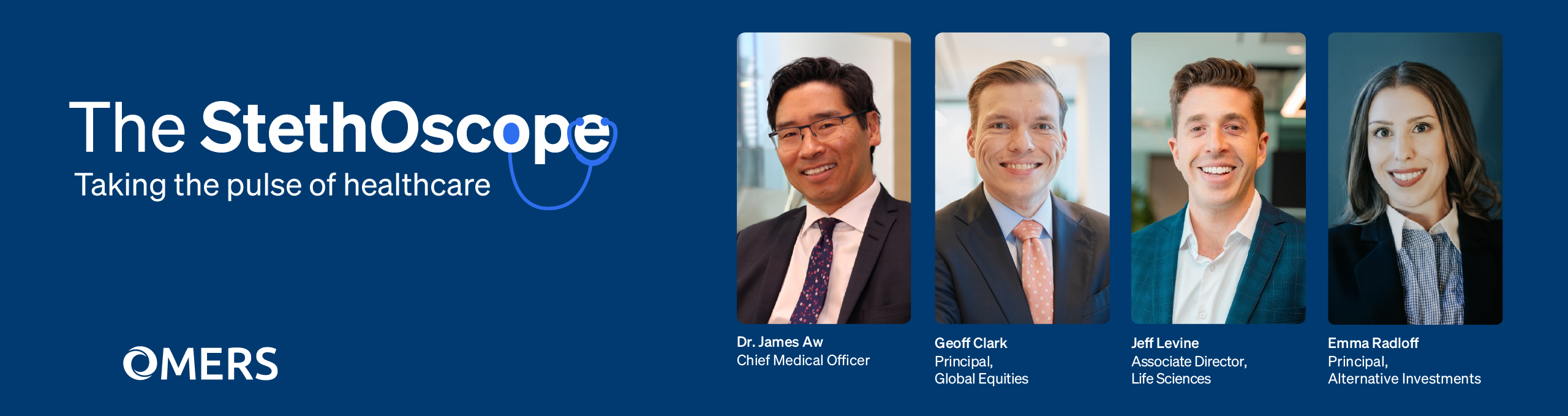
Dr. Aw: Welcome to the StethOscope! This is the third issue of the series, which was created to facilitate candid conversations with OMERS healthcare investors about the latest trends and opportunities in the rapidly evolving healthcare landscape.
One of the benefits of working for a company like OMERS is the access to our incredibly deep bench of talent across various aspects of the healthcare lifecycle. Our investment teams, for example, are often among the first to see and explore the latest healthcare solutions, even before they hit the market.
For this edition, I’m joined by experts across Global Equities, Global Credit (Alternative Investments) and Life Sciences to talk about the latest trends, tailwinds and hot topics in healthcare.
Geoff, Emma and Jeff, thanks for joining me this time. Why don’t you introduce yourselves and a bit about your investment focus before we dive in.
Geoff: Sounds good. I’m Geoff, and I sit on the Global Equities team, where we cover all publicly traded healthcare. We invest in spaces like biopharma, managed care, equipment, and devices. Our team manages about $17 billion (CAD) across all sectors, and about $2 billion of that is in healthcare.
Emma: Thanks for having us! I’m Emma and I’m on the Global Credit team with a focus on private credit. We primarily lend to upper market, sponsor owned (i.e. private equity owned) platforms. Our typical borrowers are businesses that have an enterprise value of $2.5 to 3 billion (or larger). We have about 110+ healthcare names in our portfolio which gives us pretty broad exposure into healthcare insights.
Jeff: I’m Jeff, I’m part of the Life Sciences team. Our mandate is to invest in royalty streams from license agreements between researchers and pharmaceutical companies for drugs that tackle both rare and more prevalent diseases. Currently we have about 25 drugs in our portfolio - about five of those are for rare diseases. While rare drugs are a much smaller percentage of our portfolio by count, they represent a significant share of its value. We’re also focused on growing the platform and expanding the portfolio, so we’ve been exploring new ways to do that, whether through larger deal sizes, senior secured debt to companies, or exploring adjacent markets to therapeutics.
__
Dr. Aw: Ok great. Well thanks for being here, and let’s dive right in. Let’s start with the big picture. It’s been a chaotic year – as we head into 2026, how are each of you viewing the overall healthcare investment landscape? What kinds of headwinds and tailwinds can we expect?
Geoff: I’d say I’m feeling generally positive heading into the new year. We saw a few green flags in Q4, like the Pfizer deal in September which lifted some regulatory overhangs in exchange for some relatively minor pricing concessions. Most importantly, this marked a major sentiment shift and you can see this in the biopharma rally since September. AstraZeneca signed a similar deal shortly after, and then of course the White House hosted a GLP-1 day with Eli Lilly and Novo Nordisk which gave additional clarity around pricing. So you’re seeing the whole industry benefit from these very public agreements. Valuations in the healthcare industry vs. the broader public equities market were at a 30+ year low up until the end of September. They’re still low, but we’re finally seeing some movement off the bottom, and most of that is thanks to the clearing of biopharma overhangs.
Managed care is on a similar recovery path, with Medicare Advantage profitability improving after a prior price war, so that’s another positive indication for the year ahead.
Medical devices and equipment continue to be a bit of safe haven through all the biopharma turmoil, and we expect high valuations to continue through 2026.
Overall, I think there are good signs that the market is stabilizing, but regulatory uncertainty will continue to play a huge role in the market. Even with the tariff risk removed, there are a host of other agencies like the FDA, HHS and CMS that can significantly impact biopharma profitability in the next couple of years. We’ll be keeping a close eye on that, but overall, we’re feeling positive.
Emma: We’re also constructive heading into 2026, but with some important caveats. I’d say cost control remains the dominant headwind post-COVID, especially for practice management roll-ups and acute care settings. Wage inflation, agency staffing, and integration challenges have made it structurally harder to grow margins. Cost structures tend to also be more fixed and not as easy to flex, so operators have far fewer levers when volumes soften, or reimbursement moves against them.
At the same time, we’re seeing clear tailwinds in other parts of the ecosystem like continued outsourcing in drug manufacturing, GLP-1 and small molecule driven commercial demand, and providers consolidating spend with fewer, scaled vendors.
Healthtech, which represents roughly a third of our healthcare exposure, will likely continue to be one of the most resilient and well-bid parts of the market. It’s been a private equity favorite, and we’ve certainly seen sustained deal volume in the space in 2025 . What we’re seeing is that the winners in this category are the systems that become deeply embedded in everyday healthcare workflows; think EHR, revenue cycle management, billing and payment rails. Once deployed, they basically become the infrastructure or plumbing of the business/organization. They’re sticky, mission critical, and extremely difficult/onerous to rip out.
Jeff: One of the things we’ve had to get used to this year is the constant state of uncertainty around drug pricing, distribution, and regulation. It feels like every week there was a new announcement that made us rethink how we’re evaluating these products and their path to patients. Geoff’s example of the Pfizer tariff exemption is a perfect illustration of that.
In terms of potential headwinds, the first is that the biotech fundraising market has been constrained for the past couple of years because of things like elevated interest rates, increased criticism around drug pricing, clinical trial challenges associated with the COVID pandemic and finally, just too many public biotech companies which diluted the fundraising pool and compressed valuations. Since biotech companies typically operate with negative cash flow and high capital requirements, many were valued at less than the cash they had in the bank. Companies with existing royalty streams from past developments had to solve for that by monetizing those assets. Now that interest rates have declined and sector valuations have improved, we may see companies shift toward equity financing over non-dilutive royalty sales.
On the flip side, one tailwind is the pace of innovation in biotech and pharma – it’s astronomical. For example, GLP-1s have changed how we think about treating diseases as a whole. Medications for heart disease, like the statins and the PCSK9s, have made a massive impact on the specific diseases that they're targeting, and the related downstream complications. The pace of innovation is incredible, and innovation and collaboration generate future royalties that we can buy.
And then there's a lot of really cool innovation going on in certain new mechanisms of action, whether that's gene therapy or gene editing, RNA interference, molecular glues or degradation platforms, for example. Or things that are less flashy, but are truly important to patients, like extending the dosing frequency between dosing or turning injectable drugs into oral pills for patients who are scared of needles. These innovations do double duty by helping patients and generating consistent returns for our pensioners, which makes the work feel really meaningful.
__
Dr. Aw: Speaking of the pace of innovation … we can’t talk about 2026 without getting into the AI of it all. What’s your take on what we can expect to see next year? I know we certainly hear a lot about it, but can we expect to see more of it in our day-to-day lives when it comes to healthcare?
Geoff: It’s very early but we’re starting to see some interesting AI use cases in healthcare beyond the traditional administrative efficiency gains. In biopharma, AI is being used to design and optimize clinical trials through patient selection, data collection, and reporting which can save the industry a lot of time and money. That said, new drugs still need to be tested in humans and we’re several years away from AI-developed drugs.
I’m more cynical outside biopharma where AI tools have been used to help providers boost their revenues before different AI tools from payors fight back on reimbursement. In a dynamic common to healthcare services, many AI tools are adding complexity and cost without materially improving outcomes for patients.
Emma: I’m aligned with Geoff. Some manual, rules-based workflows will definitely be automated away. But the data-rich platforms that sit closest to the clinical or billing workflow should be net beneficiaries.
A good example is the recent Press Ganey acquisition by Qualtrics (~US$6.8B), which underscores how much value the market is placing on AI that delivers clear ROI by providing insights directly tied to reimbursement, ratings, and operational performance.
__
Dr. Aw: Ok, let’s talk about what gets you up every morning. Jeff, you mentioned feeling like your work felt really meaningful because of the end impact on patients. What do each of you like most about your job?
Geoff: I’d say for me it’s about how much time we get to spend learning about things that are so fundamentally important to so many people. What matters more than health? We’re paid to learn, and we have phenomenal access to incredible resources. Every week I’m talking to management teams, physicians, researchers… where else can you find that kind of opportunity. It’s a very competitive industry, but that’s what makes it fun. You need to have a differentiated view to outperform, so it’s a mix of learning new things and then looking at those things in new or unique ways.
Emma: Getting to know the intricate details of so many different kinds of businesses is always interesting, but healthcare is where tech and patient impact really intersect, and that’s particularly exciting. We get to learn a lot about how new services and technologies will evolve the healthcare industry in our lifetime, through a lens of how it will affect the end consumer – like what Jeff said. On top of that, the mission of the team feels really aligned with the OMERS promise. Our members will actually benefit directly from some of the companies we invest in, as well as from the returns we generate and that gives us a real sense of purpose.
Jeff: I’ll echo what Emma said - it’s rewarding to know our investments help drive drug developments that can improve quality of life or even save lives. Healthcare impacts all of us directly. So it's a really important place for us to have exposure to and be invested in. While we don’t invest directly in unproven, early‑stage drugs, many of the companies we finance are using the capital we invest to advance novel medicines for patients with unmet medical needs.
From a personal perspective, I get to speak to experts and key opinion leaders to learn about all types of conditions, dig into the science, and really understand how different drugs are working. My undergraduate and my master's degree are both in physiology and pharmacology, so getting to analyze the clinical landscape and work together with companies to really understand the market opportunity and how can we help these patients have a better experience, is the best of all worlds combined.
__
Dr. Aw: It’s interesting - I start each of these conversations eager to learn about new perspectives on the healthcare landscape, but I always end them with a real sense of gratitude to work alongside investors that really believe in the mission of OMERS and the work they do individually. The investments we make are ultimately about improving patient outcomes, whether through rare disease drugs, scalable service models, or innovative technologies. It’s obvious that you each take your role seriously, and I admire that. Thank you all for your insights. As always, this kind of collaboration will increase our collective understanding and ability to identify opportunities and risks in the complex healthcare landscape.
The information, content and material provided by OMERS Administration Corporation at each link on this page is provided for informational purposes only and is not intended to be, or to substitute for, medical advice. Always seek the advice of a qualified healthcare professional if you have any questions regarding a medical condition or treatment and do not disregard or delay seeking professional medical advice because of the content provided at any of the links on this page. OMERS AC and its affiliates and other investment entities are not responsible or liable in any manner for your use of or reliance on the above information.